

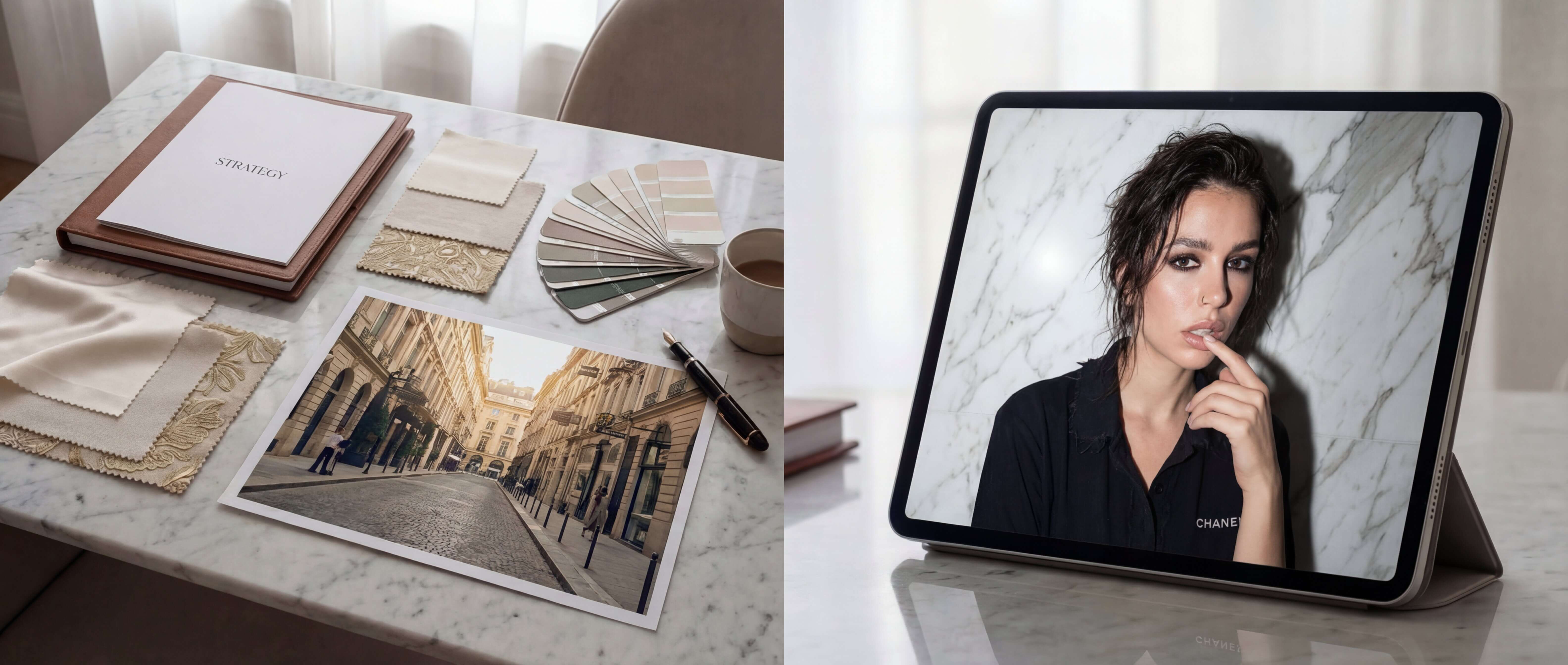
Luxury fashion brands today face a major challenge: how to remain exclusive while staying digitally relevant. Social media demands constant presence, continuous content, and regular interaction with the audience. Traditional influencers bring visibility, but also limitations – inconsistent communication, high costs, reputational risk, and limited brand control.
This blog explores how a strategically developed AI influencer could increase both sales and long-term brand value for a luxury fashion label.
1. The Challenge for Today’s Luxury Fashion Brands
Premium fashion brands want to:
- Maintain exclusivity
- Build a strong identity
- Keep full control over visuals and messaging
- Scale online sales
Problems arise when a brand relies solely on external influencers. Every collaboration is a new investment. Every campaign is a separate project. Every post is a compromise between the brand and the person promoting it.
Long-term, this is not a scalable model.
2. What Would an AI Influencer for a Luxury Brand Look Like?
An AI influencer for a premium fashion brand wouldn’t be a generic “digital model”.
They would be:
- A carefully designed character with a defined personality
- Visually aligned with the brand’s aesthetic
- Stylistically consistent across all collections
- A long-term brand ambassador
For example, the brand could develop a digital ambassador who embodies:
- Sophistication
- Minimalist elegance
- Contemporary luxury
- An international lifestyle
Unlike a traditional influencer, this character never steps outside the brand’s boundaries.
3. A Content Strategy That Drives Sales
An AI influencer is not just there to make the feed look pretty.
They become the brand’s central communication channel.
- Showcasing new collections
- Behind-the-scenes style digital editorials
- Interactive polls and Q&A
- Storytelling around collection inspiration
TikTok
- Fashion styling videos
- Outfit transition clips
- Trend-based content adapted to a luxury context
Website and webshop
- AI influencer as a virtual guide through the collection
- Personalized outfit recommendations
- Launch campaigns for new lines
This approach creates continuity – and continuity builds trust, which ultimately drives sales.
4. Financial Aspect: Why This Is Profitable Long-Term
Traditional influencer model:
- Pay-per-campaign
- Additional production costs
- Unpredictable availability
- Reputation risk
AI influencer model:
- One-time investment in development
- Controlled, in-house content production
- Unlimited availability
- Full reputational safety
Over time, the AI influencer becomes the brand’s digital asset – an owned property that continuously generates value.
5. Potential Results
In a realistic scenario, a luxury fashion brand implementing an AI influencer could expect:
- Higher engagement through consistent storytelling
- Growth in online sales thanks to stronger emotional connection
- Stronger brand identity recognition
- Reduced long-term marketing costs
Most importantly, the brand no longer depends on external individuals. It owns its own media channel.
6. Long-Term Market Advantage
Brands that adopt AI influencers early gain:
- An innovative image
- Clear differentiation from competitors
- Full creative freedom
- A scalable growth model
In the luxury segment, the perception of innovation and control often translates into a perception of higher value.
Conclusion
An AI influencer for a luxury fashion brand is not a replacement for humans.
They are a strategic tool.
They are a digital ambassador who:
- Never compromises the brand
- Never steps outside the brand identity
- Does not create reputational risk
- And can evolve alongside the brand for years
In a world where attention is the most expensive currency, owning a fully controlled media channel is becoming one of the greatest competitive advantages.
If you’re considering how an AI influencer could be developed specifically for your brand, the first step is a strategic analysis – because success doesn’t come from technology alone, but from correct implementation.
Author: Marin Jusup, Founder & Creative Director, CodeModels.AI